Factory N+1
Note, November 2026: this post is about the hackathon build, a simulated warehouse floor. It started N+1 Labs, which runs on a separate engine built for hardware assembly lines.
Won NVIDIA’s Best Use of Nemotron at the Crusoe Recursive Agents Hackathon yesterday, building Factory N+1. Walked out with an RTX 5090 GPU.
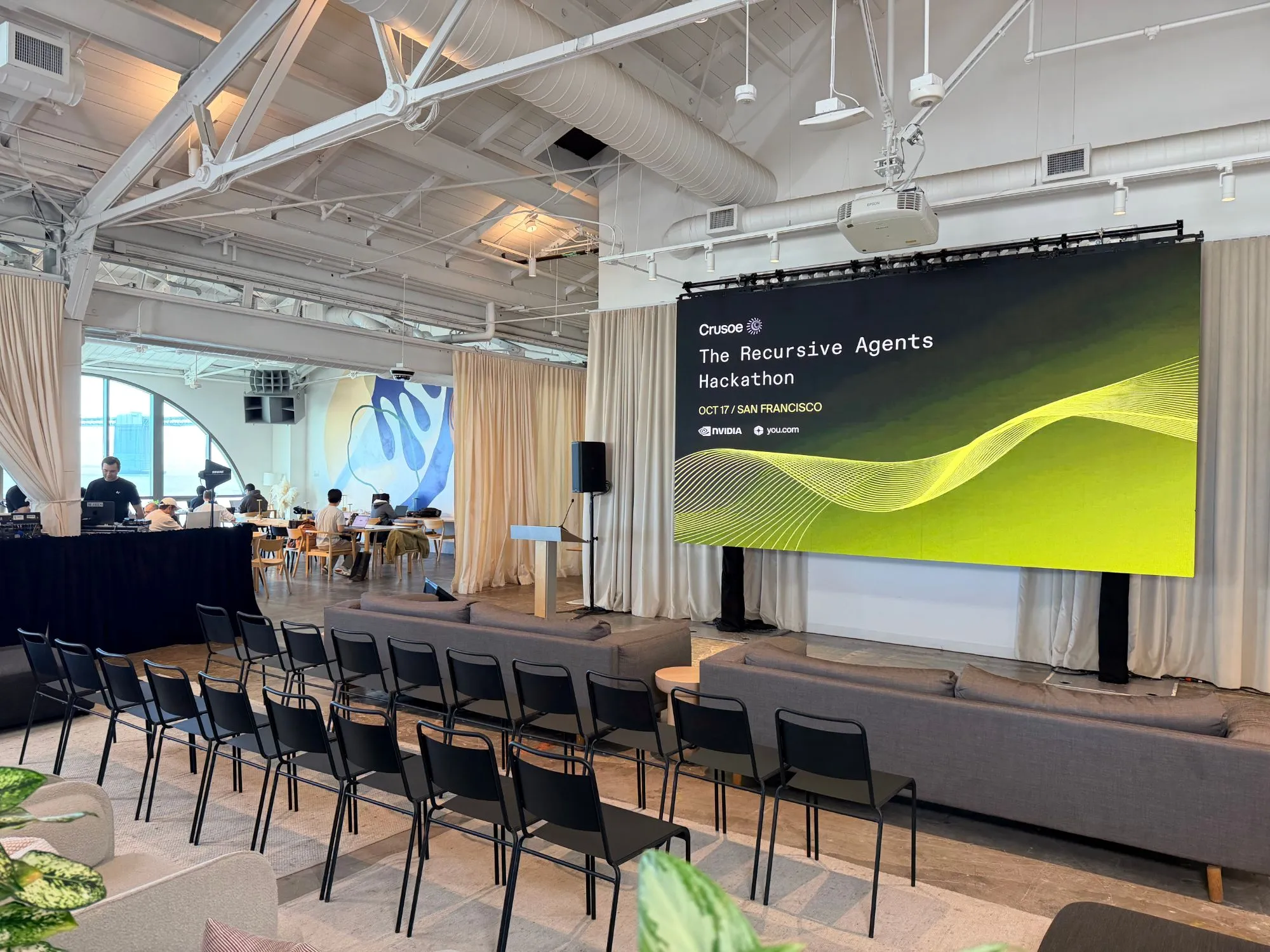
I realized what I’m chasing at hackathons. My flow state.
Headphones on. Agents running. 6 hours straight, bathroom breaks only, and I don’t feel the time passing. A room full of builders racing the same deadline. Nowhere else do I hit that state this often.
The problem I brought in is one I’ve wanted to solve since my years on factory floors.
Changing a floor is a battle. Capital, time, and downtime while the line sits idle. I wanted agents that prove a change in simulation first, then keep pushing throughput, yield, quality and utilization, run after run, against one fixed score.
What I built. Factory N+1, a prototype to validate the system on a simple logistics facility. Trucks in, receive, sort, pack, ship out to 3 zones, 100 packages a day. Nemotron 3.5 Lightning researches warehouse practice through You.com.
Nemotron 3.5 Super VL proposes new floors and tests its drafts in the simulator before submitting. The same frozen simulator scores every run. N+1 only ships if it beats N.
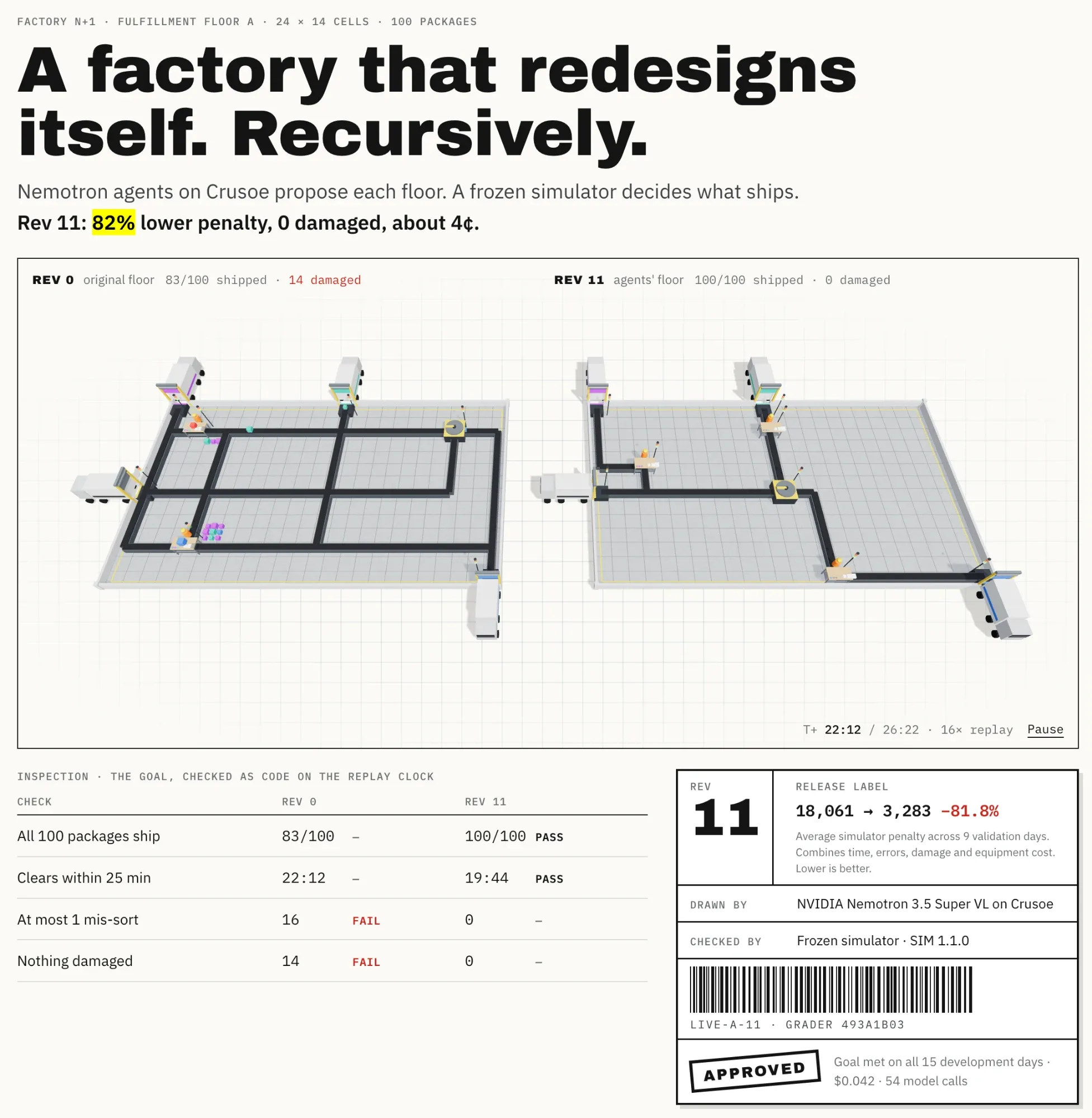
My 11th run hit the best score. 82% lower penalty. Zero damaged, zero mis sorts, 54 model calls, 4 cents.
What broke. Lightning made up a simulator result, and the grader caught it. The agents kept getting route distances wrong until I gave them a ruler tool. Shared memory made them worse on new factories, 0 for 4.
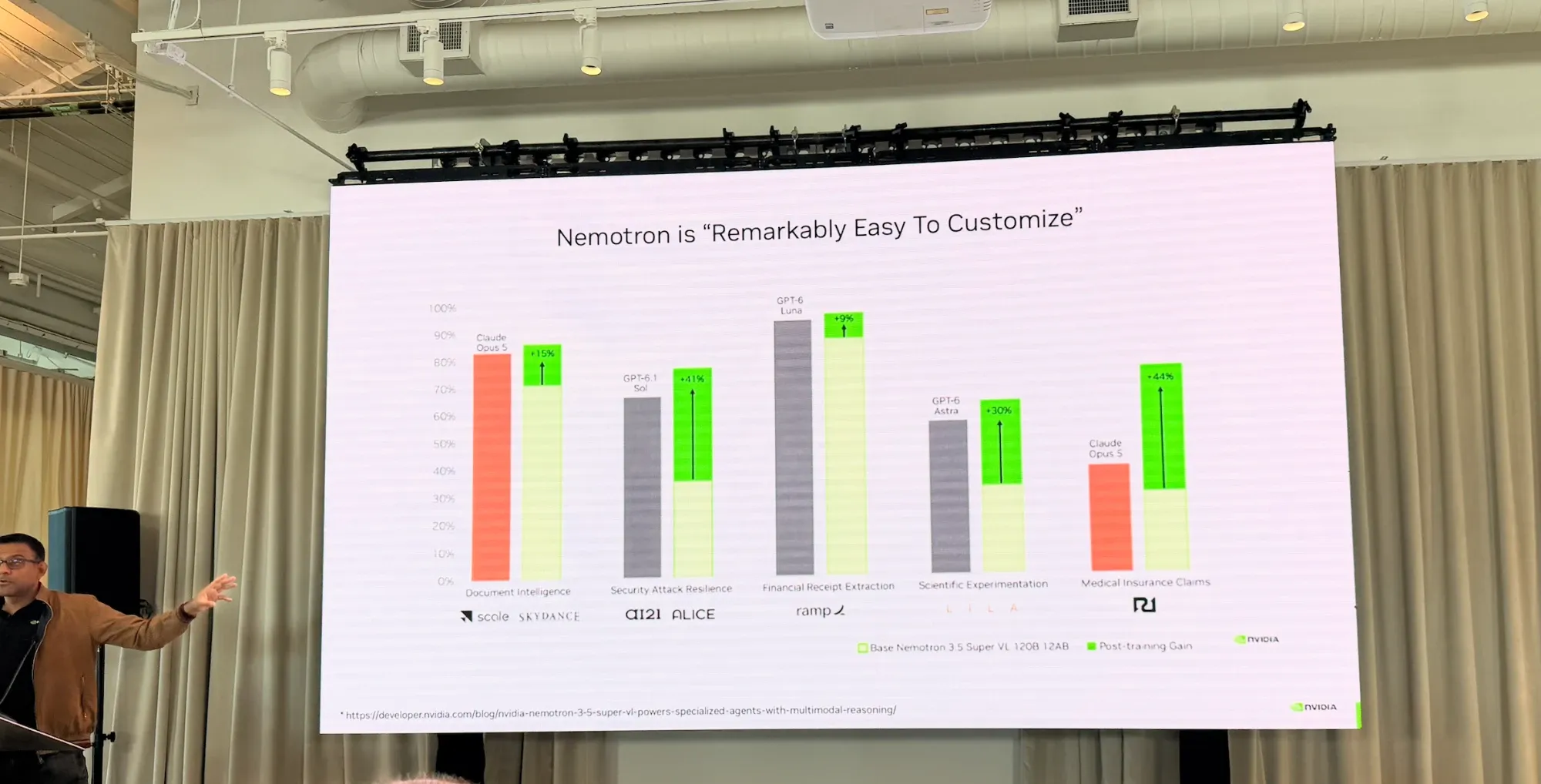
During the presentations, one NVIDIA slide caught my eye. A post-trained Nemotron 3.5 Super VL beating Claude Opus 5 and GPT-6 on specialized tasks. I had to explore this. So I took some build time, spun up a Crusoe A100 and fine-tuned Nemotron Nano 8B twice on synthetic factory data labeled by my simulator.
The critic learned the output format (0/100 to 100/100) but couldn’t predict outcomes. The optimizer worked. 1,200 labeled moves, 708 seconds of training.
The base model improved the score 0.14%, random moves 4.27%, the fine-tuned model 12.64%. I ran out of time to wire it into the main loop, so the 82% came from the stock Nemotron models. The fine-tune is the N+1.
The RTX 5090. Launched at $1,999 in January 2025. With the shortage it’s listed near $8,500 on Amazon this week. I’ve watched that price climb for months. Very grateful for this one. My next fine-tune runs on my desk, on my own data.
I’ve been fascinated by digital twins for a while.
Most of them show you what you have. I want the one that shows you what’s next, and proves it. Factory N+1 was the first piece. The end goal is a digital twin of a full factory, with a world model that understands the physics of every action and reaction. A place where humanoid robots, advanced vision systems and AI control get placed and proven before they touch the real line. More soon!
Thanks to NVIDIA, Crusoe, Cerebral Valley, and You.com!