Hackathon field report
AIE Code Summit 2026 Hackathon, Cerebral Valley
submittedBuilt Closeout solo. A factory failure closes only when a held-out build proves the fix. Agents score the causes, patch the firmware and try to break the claim. Compiled code decides.
Prototype
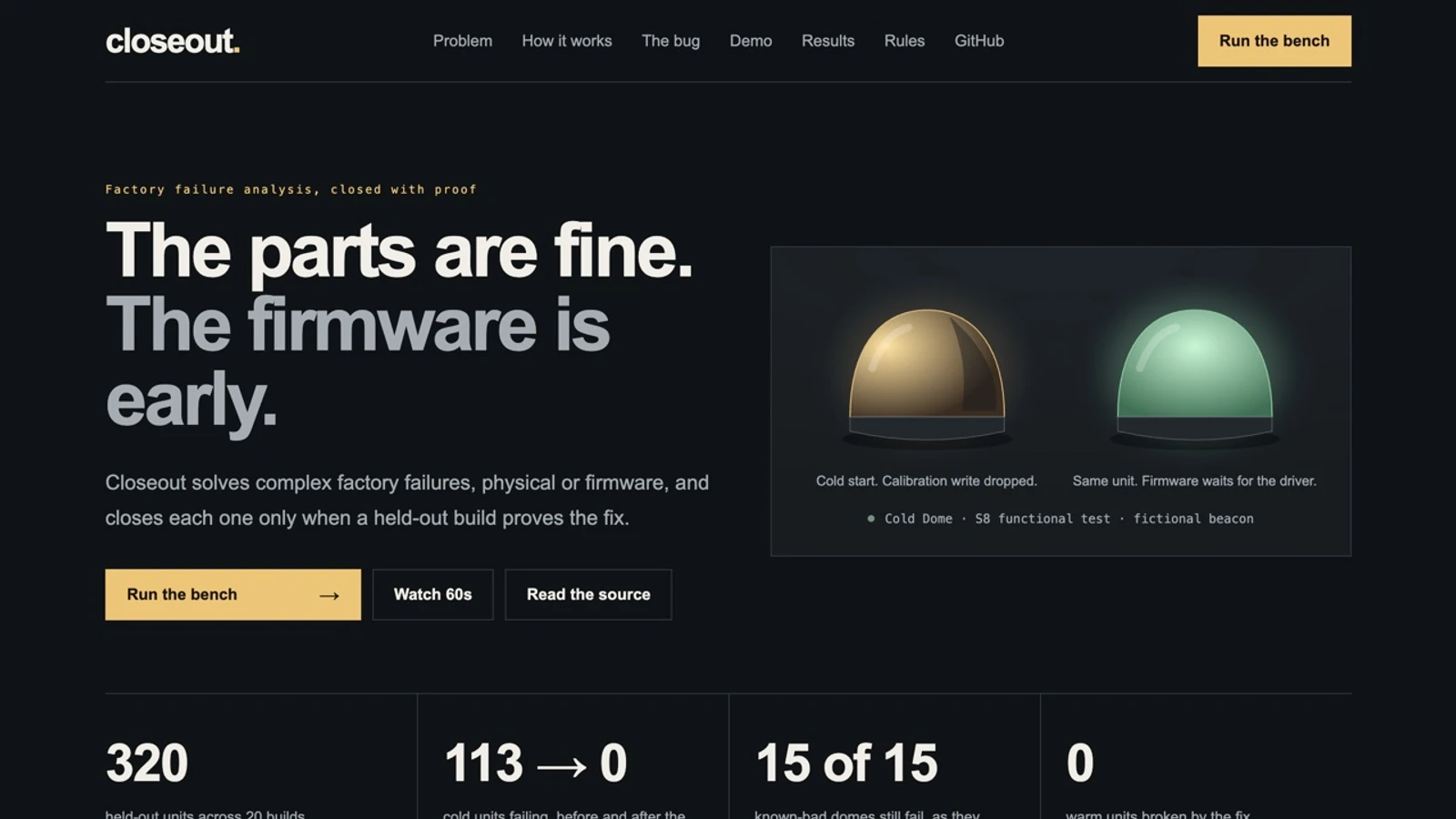
Built solo at the AIE Code Summit 2026 Hackathon, hosted by Cerebral Valley at SHACK15 in San Francisco on November 7, 2026. I took Problem Statement Three, Trust but Verify. 81 projects were submitted. Mine didn’t place.
The problem I chose
Every hardware program runs a Major Issues List. One row per open failure: station, rate, owner, suspected cause.
Items close on a yield bump. Then the defect comes back.
The expensive ones cross team lines. Logged as Material. Fixed in Firmware. Owned by no one.
Closeout makes a fix earn its close.
What shipped
- The line. A fictional station beacon built on an 8-station line. One seeded fault carries the demo, Cold Dome: one side of the dome glows dim, and the issue list blames the LED lot.
- The bug. The parts are fine. A second-source LED driver needs 180 ms to wake up cold. The firmware writes its calibration at 50 ms, so the write drops.
- The fix. The corrected firmware waits for the driver. Both revisions are real C, compiled and run per synthetic unit on the server.
- The shortcut. Widen the optical limit and yield looks fixed. It also lets a known-bad dome through, so the gate rejects it.
- The proof. 20 held-out builds, 320 synthetic units. Cold failures went from 113 to 0. All 15 known-bad domes still fail. No warm unit broke.
Toolset
- SubQ Snap 1.1 (Subquadratic): triage. One call scores every failed unit against every cause, up to 128 decisions. The top score in the demo was 0.80 for the cold driver, under the 0.85 bar, so it stays a lead.
- Muse Wonder (Meta Model API): the fixer. It writes candidate C patches. A patch is code, so it can be run and checked.
- Gemini 4 Argon (Google DeepMind): the doubter. It gets the evidence and the claimed cause, never the fixer’s reasoning, and tries to break the claim.
- MongoDB Atlas: the issue list as a ledger. It refuses a confirmed cause without a teardown finding, and a close before the held-out builds pass.
- C and a simulated hardware layer: the referee. Pass or fail comes from compiled code, never from a model.
- Next.js on Vercel: the live bench. Reproduce the failure, try the shortcut, run the fix, then run 20 held-out builds.
What was hard
- The first picker lost. Failure analysis teardowns are scarce, so Closeout picks which units to open. On the first scenario my picker explained fewer failures than random picks or worst-first. The final run measured it across 24 sealed scenarios: 1 teardown to root cause on average, against 1.08 for random and 3.71 for worst-first. A small edge over random, not a rout.
- Scores aren’t probabilities. The first calibration check said about 93% and was right 71% of the time. So the page calls them scores. A score picks the next test. It never confirms a cause.
- Live versus replay. The browser runs real C. The SubQ call and the engine trace are recorded, and the page says so. The browser never writes a new patch or touches the ledger.
What I learned
- Scores suggest. Evidence decides.
- Keep a known-bad unit in every run. A fix that lets it pass isn’t a fix.
- A blind reviewer needs a different context. Gemini never saw what Muse was thinking.
- The next build is the judge.
The product, the line and every unit are fictional and synthetic. Closeout is a hackathon prototype, not an N+1 Labs product.